



Why Are Backlinks Important? Full Guide to Better SEO Performance
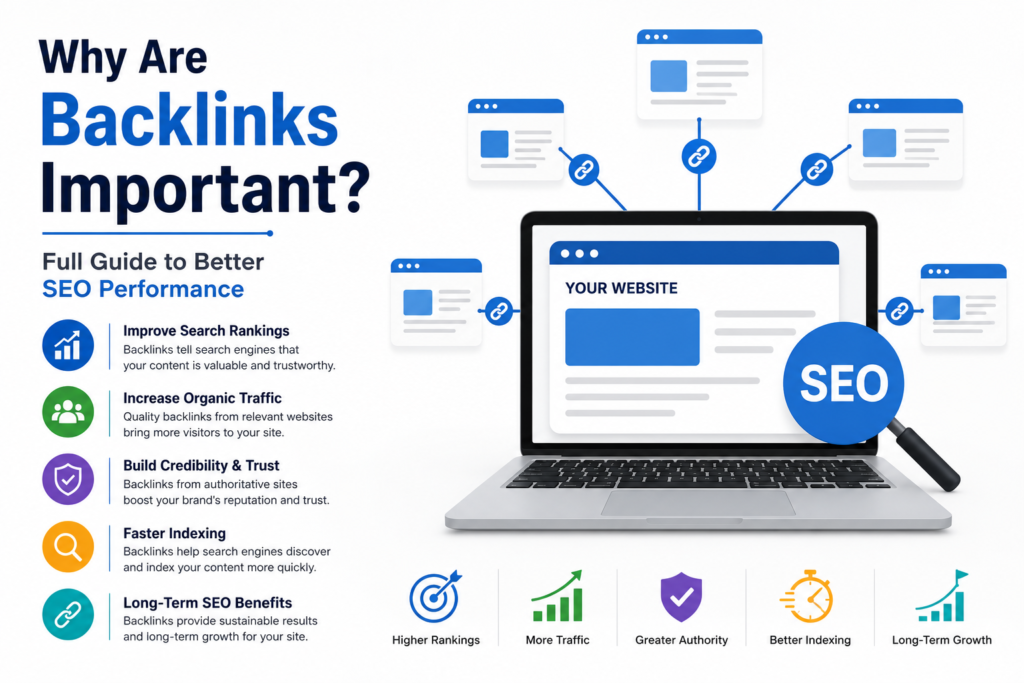
Backlinks are important because they help search engines discover pages, understand relationships between websites, and evaluate whether a page is credible enough to appear prominently in search results. A relevant backlink from a trusted website can also send qualified visitors, increase brand awareness, and strengthen a site’s reputation within its industry.
However, backlinks are not automatic ranking boosts. Modern search engines examine the source, relevance, placement, anchor text, and purpose of a link. One genuine editorial link from a respected industry publication may be more valuable than hundreds of links from unrelated directories or low-quality websites.
This guide explains what backlinks are, why they matter for SEO, what separates good links from risky ones, and how to build a sustainable backlink strategy.
What Is a Backlink?
A backlink is a hyperlink on another website that points to a page on your website. Backlinks are also called inbound links or incoming links.
For example, imagine a cybersecurity company publishes original research about phishing attacks. A technology publication references the findings and links to the original report. That link is a backlink for the cybersecurity company.
Backlinks are different from:
- Internal links: Links between pages on the same website.
- Outbound links: Links from your website to another website.
- Backlinks: Links from another website to your website.
All three types of links help users navigate information, but backlinks are especially important because they represent third-party references to your content.
Google states in its official link best-practices documentation that it uses links to discover pages and as a signal when determining page relevance.
Why Are Backlinks Important for SEO?
Backlinks influence SEO in several connected ways. Their value is not limited to rankings.
1. Backlinks Can Support Higher Search Rankings
Search engines want to show pages that are relevant, useful, and trustworthy. When reputable websites voluntarily reference a page, those links provide evidence that the page may be valuable.
Consider two articles targeting the same keyword:
- Article A is detailed but has no links from other websites.
- Article B is equally detailed and has earned links from universities, industry publications, and respected experts.
If the pages are otherwise comparable, Article B has stronger external evidence supporting its credibility.
This does not mean the page with the most backlinks always wins. Google uses many systems and signals when ranking content, including relevance, content quality, usability, freshness where appropriate, and protections against spam. Its official ranking systems guide explains that search results are produced using multiple signals rather than one isolated factor.
Backlinks are most effective when the linked page already provides a strong answer to the searcher’s question. Links cannot permanently compensate for thin content, poor search intent alignment, or a technically broken website.
2. Links Help Search Engines Discover Pages

Search engines use automated crawlers to move between web pages. When a crawler reaches a page containing a link, it may follow that link and discover the destination.
This is especially useful for:
- Newly launched websites.
- Recently published articles.
- Pages that are buried deep within a site.
- Research reports and resources with few internal links.
- Websites that are not crawled frequently.
A backlink does not guarantee indexing, and an XML sitemap is still important. However, links provide additional paths through which crawlers can reach your content.
Your website structure matters too. Before investing heavily in outreach, make sure visitors and crawlers can navigate the site easily. The comparison of a custom website versus WordPress for business explains how platform choice, performance, URLs, and technical control can affect long-term SEO work.
3. Backlinks Build Topical Credibility

A link is more meaningful when it comes from a website that is closely connected to your subject.
For example:
- A dental association linking to a dentist’s oral-health study is highly relevant.
- A construction publication linking to a contractor’s building-cost report is relevant.
- An unrelated entertainment directory linking to the same contractor is less meaningful.
Relevant links help create a clearer relationship between your website and its subject area. If respected websites in the same industry consistently cite your resources, search engines and readers have more evidence that your website contributes useful information to that field.
This is why topical relevance often matters more than a website’s general popularity.
4. Backlinks Generate Referral Traffic
People can click backlinks, making them a direct source of visitors.
A link from a relevant article can send highly qualified traffic because readers are already interested in the subject. For instance, a link from an article comparing ecommerce platforms may send store owners to a resource about ecommerce tools for scaling an online store.
Referral visitors may:
- Read additional pages.
- Join an email list.
- Download a resource.
- Request a quotation.
- Purchase a product.
- Share or reference the content later.
A backlink that sends genuine customers can be valuable even when it is marked nofollow and provides limited or uncertain ranking value.
This is an important distinction: the best links support both visibility and business results.
5. Backlinks Increase Brand Awareness
A mention on a respected industry website places your brand in front of an audience that may not know you.
Readers may not click immediately, but repeated exposure can build familiarity. Over time, this can lead to:
- More branded searches.
- Direct website visits.
- Social media mentions.
- Newsletter subscriptions.
- Partnership opportunities.
- Invitations to contribute expert commentary.
- Additional natural backlinks.
This is one reason digital public relations can produce wider benefits than traditional link building. A successful campaign can earn links while also improving reputation, visibility, and trust.
6. Backlinks Can Strengthen Linkable Pages Across a Website
External links usually point to a specific URL, not equally to every page on the domain. The linked page can then use internal links to guide readers and crawlers toward related resources.
Suppose a research report earns 30 backlinks. The report could internally link to:
- A related service page.
- A detailed methodology article.
- A product comparison.
- A case study.
- A supporting beginner guide.
This creates a logical route from the popular resource to important pages that may be harder to promote directly.
A scientific explainer such as how Artificial Intelligence is accelerating scientific discovery is an example of content that can become linkable when it combines clear explanations, real research, useful examples, and original organization.
What Makes a High-Quality Backlink?
Not every backlink carries the same value. Evaluate each opportunity using the following factors.
Topical relevance
The linking page should have a logical relationship with the destination page. A link does not need to come from an identical niche, but readers should understand why it is there.
Editorial purpose
Strong links are usually included because a writer, editor, researcher, or organization believes the destination helps the reader.
A contextual link inside a useful article is generally more meaningful than a random link added to a footer, profile, or list containing hundreds of unrelated websites.
Source credibility
Consider whether the linking website:
- Publishes identifiable authors.
- Has a clear editorial purpose.
- Produces original content.
- Attracts a genuine audience.
- Has a history of covering the subject.
- Avoids obvious link selling and spam.
Third-party metrics such as Domain Rating or Domain Authority can help with comparison, but they are not substitutes for manual evaluation. A high score does not automatically make a website relevant, trustworthy, or safe.
Page quality
Evaluate the specific linking page rather than looking only at the domain.
A respected website may contain old, thin, user-generated, or unrelated pages. A strong link should appear on a page that has a clear topic, useful information, and a genuine reason to reference your content.
Link placement
A link placed naturally within the main content usually provides more context than one placed in a sidebar, author biography, template, or sitewide footer.
Placement also affects clicks. Readers are more likely to follow a link when it appears beside information that creates a reason to learn more.
Anchor text
Anchor text is the clickable wording of a link.
Useful anchor text describes the destination naturally. Examples include:
- “Google’s link spam policies”
- “study on consumer payment behavior”
- “complete local SEO checklist”
- The name of the company or report
Avoid trying to force the same keyword-rich anchor text into every backlink. A natural profile normally includes branded anchors, page titles, partial-topic descriptions, URLs, and general phrases.
Unique referring domains
Several links from one website may still be useful, particularly when they send traffic. However, earning references from different reputable websites generally provides broader third-party validation than repeatedly acquiring links from one source.
Audience value
Ask a simple question: could the right person discover this link and find the destination genuinely helpful?
A smaller niche publication with the correct audience can produce better traffic, leads, and industry recognition than a large but unrelated website.
Dofollow, Nofollow, Sponsored, and UGC Links
Website owners can use link attributes to explain the nature of certain outbound links.
Standard links
A normal link without a special rel attribute is eligible to be crawled and interpreted normally.
Nofollow links
A nofollow attribute tells search engines that the publisher does not want to provide a standard endorsement through the link.
Nofollow links are not necessarily worthless. They can still generate traffic, increase brand exposure, help readers find resources, and lead to future mentions.
Sponsored links
Paid placements, advertisements, sponsorships, and similar commercial links should use rel="sponsored".
UGC links
Links added through user-generated content, such as comments and forum posts, can use rel="ugc".
Google provides implementation guidance in its documentation on how to qualify outbound links.
How Many Backlinks Do You Need?
There is no universal number.
The number required depends on:
- Keyword competition.
- Search intent.
- Content quality.
- Strength of competing pages.
- Relevance of the links.
- Authority of the referring sources.
- Age and reputation of the website.
- Quality of the overall site.
A local service page targeting a low-competition town may rank with few external links. A national finance, software, or insurance keyword may require a much stronger combination of content, reputation, and authoritative references.
Instead of asking, “How many backlinks do I need?” ask:
- Which pages currently rank for the keyword?
- How many relevant referring domains support those pages?
- What types of websites link to them?
- Why did those sources choose to link?
- Is my content meaningfully better or more useful?
- Can I earn links the competitors cannot easily copy?
Quality and competitive context matter more than reaching an arbitrary total.
How to Build High-Quality Backlinks
1. Create Something Worth Referencing
Most websites struggle with backlinks because their content gives publishers no compelling reason to link.
Strong linkable assets include:
- Original research.
- Industry surveys.
- Free calculators.
- Templates and checklists.
- Detailed statistics pages.
- Interactive tools.
- Maps and visualizations.
- Expert roundups with original insights.
- Case studies with measurable results.
- Definitive explanations of difficult subjects.
Ordinary product and service pages are important for conversions, but they are often difficult to promote editorially. Supporting resources give other websites a more natural reason to reference your business.
New founders exploring business ideas to start in 2026 should consider linkable content during the planning stage rather than waiting until the website has already launched.
2. Analyze Competitor Backlinks
Use a backlink research platform to compare your website with three to five genuine search competitors.
Look for:
- Websites linking to several competitors but not you.
- Competitor pages that attract the most links.
- Broken competitor pages that still have backlinks.
- Industry resource pages.
- Journalists covering your topic.
- Associations and organizations citing similar information.
- Unlinked brand or product comparisons.
Do not copy every competitor link. Some may be paid, outdated, irrelevant, or impossible to reproduce. The goal is to understand what kinds of content and relationships earn attention in your niche.
3. Use Broken Link Building
Broken link building involves finding a relevant page that links to a missing resource, creating or identifying a suitable replacement, and contacting the publisher.
A practical process is:
- Find a broken external link on a relevant website.
- Confirm that the missing page previously covered a topic you can address.
- Create a genuinely useful replacement.
- Check that your page matches the original context.
- Inform the publisher about the broken link.
- Suggest your resource without demanding placement.
This strategy works best when you help the publisher fix a real problem. Sending mass emails about unrelated broken links usually produces poor results.
4. Publish Original Data
Journalists and bloggers need evidence to support their articles. Original data gives them a reason to cite you.
You could publish:
- Customer survey findings.
- Anonymous usage trends.
- Pricing benchmarks.
- Local market reports.
- Industry hiring data.
- Before-and-after performance results.
- Analysis of public datasets.
Explain the sample size, date, collection method, and limitations. Transparent methodology increases trust and makes the resource easier to cite.
5. Contribute Expert Commentary
Journalists, newsletter writers, podcasters, and industry bloggers regularly need expert explanations.
Good commentary is:
- Specific.
- Short enough to quote.
- Based on relevant experience.
- Free from promotional language.
- Supported by an example or data point.
Provide useful insight first. A backlink is a possible outcome, not something every journalist is required to provide.
6. Reclaim Unlinked Mentions
A website may mention your brand, research, product, or founder without including a link.
Search for those mentions and contact the publisher when adding a link would genuinely help readers identify the source.
Do not request a link for every passing reference. Focus on cases where the website discusses your data, quotes your team, uses your image, or names a resource readers may want to access.
7. Conduct Personalized Outreach
Outreach should explain why your resource matters to that specific recipient.
A useful email includes:
- A clear subject.
- A genuine reason for contacting the person.
- The exact page you reviewed.
- A brief explanation of your resource.
- The reason it benefits their audience.
- One simple request.
Avoid generic praise and lengthy introductions. Do not hide the purpose of the message.
Teams managing a large number of publisher conversations may benefit from structured inbox workflows and the right email management tools.
Backlink Mistakes to Avoid
Buying links that pass ranking value
Paying for links intended to manipulate rankings can violate Google’s spam policies. This includes direct purchases, disguised advertorials, paid guest posts, and product exchanges that are not properly qualified.
Google’s official spam policies list link spam practices that can lead to ranking losses or removal from search results.
Chasing quantity instead of relevance
Hundreds of automated directory links are not a substitute for a small number of legitimate industry references.
Overusing exact-match anchors
Repeated keyword anchors can create an unnatural pattern. Let publishers choose wording that fits their sentences.
Using private blog networks
A private blog network is built or controlled mainly to create links. These networks may appear useful temporarily, but they create unnecessary risk and little genuine audience value.
Publishing low-value guest posts at scale
Guest contributions can build relationships and visibility when they contain real expertise. Producing large numbers of thin articles solely to insert links is different and may be treated as manipulative.
Exchanging links excessively
Occasional reciprocal links can happen naturally between businesses and resources. Large-scale “link to me and I will link to you” arrangements create a detectable pattern and provide little reader value.
Ignoring the destination page
Outreach cannot rescue an outdated, slow, confusing, or shallow page. Improve the resource before asking other websites to recommend it.
Sending every backlink to the homepage
Deep links to research, tools, guides, categories, and useful product resources create a more natural profile and send readers directly to the information they need.
Disavowing links without a clear reason
Most website owners do not need to disavow every strange or low-quality link they discover. Search engines can ignore many spammy links automatically. The disavow process should generally be reserved for serious situations involving manipulative links or manual-action concerns.
How to Check and Measure Your Backlinks
Google Search Console provides a free Links report showing top linked pages, top linking sites, and commonly used linking text. The report is useful for understanding broad patterns, although it should not be treated as a complete list of every link Google knows about. Review the official Search Console Links report guide for details.
Track these metrics:
Referring domains
Measure how many unique websites link to you, not only the total number of links.
Relevant new links
Review whether recent links come from websites connected to your topic and audience.
Target-page performance
Check whether pages earning links improve in impressions, rankings, clicks, engagement, or conversions.
Referral traffic
Use analytics to identify which links send visitors and whether those visitors take meaningful actions.
Link velocity
Monitor the general pace of link acquisition. Sudden unexplained spikes may indicate spam, while steady growth often reflects ongoing content promotion and brand recognition.
Lost links
A page may lose links when a publisher updates an article, removes content, changes URLs, or replaces your resource. Reclaim worthwhile lost links when appropriate.
Business outcomes
The final measure is not the backlink count. Evaluate leads, subscriptions, sales, partnerships, branded searches, and qualified visitors.
Backlinks vs. Internal Links: Which Matters More?
You need both.
Backlinks bring external validation, referral visitors, and discovery paths from other domains. Internal links organize your own website, clarify page relationships, distribute attention, and help users move between related resources.
A practical strategy is:
- Earn backlinks to strong informational resources.
- Add natural internal links from those resources to related pages.
- Keep important pages within a few clicks of the homepage.
- Use descriptive internal anchor text.
- Update old articles with links to newer, relevant pages.
Backlinks attract authority and attention from outside the website. Internal links help use that attention effectively.
Frequently Asked Questions
Why are backlinks important?
Backlinks help search engines discover content and evaluate its relevance and credibility. They can also send referral traffic, build brand awareness, and connect your website with respected sources in your industry.
Are backlinks still important for SEO?
Yes. Google continues to use links for discovery and as a relevance signal, but backlinks operate alongside content quality, search intent, usability, technical SEO, and many other systems.
Can a website rank without backlinks?
Yes, particularly for low-competition or highly specific queries. Backlinks usually become more important when competing for established commercial topics and broader keywords.
How many backlinks should a new website build each month?
There is no safe or ideal monthly number. Focus on earning relevant links at a natural pace through useful content, outreach, partnerships, and public relations.
What is the best type of backlink?
A strong backlink is editorially placed on a trustworthy, topically relevant page and gives readers a genuine reason to visit your content.
Are nofollow backlinks useful?
They can be. Nofollow links may send qualified traffic, increase brand awareness, help people discover your content, and lead to additional mentions.
Do backlinks from social media improve rankings?
Most social platforms qualify outbound links, so direct ranking value may be limited. Social visibility can still help your content reach journalists, bloggers, customers, and other people who may later create editorial links.
Are directory backlinks bad?
Not automatically. Legitimate industry, professional, local, and business directories can help users. Low-quality directories created mainly to sell or exchange links provide little value and may create risk.
How long do backlinks take to affect rankings?
There is no fixed timeline. Search engines must discover and process the link, and the result depends on the page, source, competition, and other ranking signals. Changes may take days, weeks, or longer.
Should I buy backlinks?
Avoid buying links intended to influence rankings. Paid placements should provide genuine advertising or audience value and should be properly marked as sponsored.
Conclusion
Backlinks are important because they provide external evidence that a page is useful enough to reference. They can strengthen search visibility, help crawlers discover content, send relevant visitors, and establish a brand within its industry.
The most effective backlink strategy is not based on purchasing large quantities of links or copying every competitor. It begins with a technically sound website and content that offers something worth citing—original data, expert guidance, useful tools, clear explanations, or practical resources.
Audit your existing links, study the pages earning references in your niche, improve one linkable asset, and promote it to carefully selected publishers. Measure the resulting traffic, rankings, and business outcomes rather than treating the backlink count as the final goal.
A smaller number of credible, relevant links earned over time will usually support stronger long-term SEO performance than a large collection of links created only to influence an algorithm.
