



Custom Website vs WordPress for Business in 2026: Which One Should You Choose
If you are starting a business or fixing up an old website, you have probably asked yourself this question. Custom website vs WordPress for business in 2026 is one of the biggest choices you will make before you spend a single rupee or dollar on your online presence. Pick the wrong one and you may end up paying for a rebuild in a year. Pick the right one and your website works quietly in the background while you focus on running your business.
This guide breaks the whole thing down in plain language. No confusing tech talk. Just clear answers about cost, speed, SEO, security, and which option actually fits your business today.
What Is WordPress and What Is a Custom Website
Before comparing them, let us make sure we are talking about the same things.
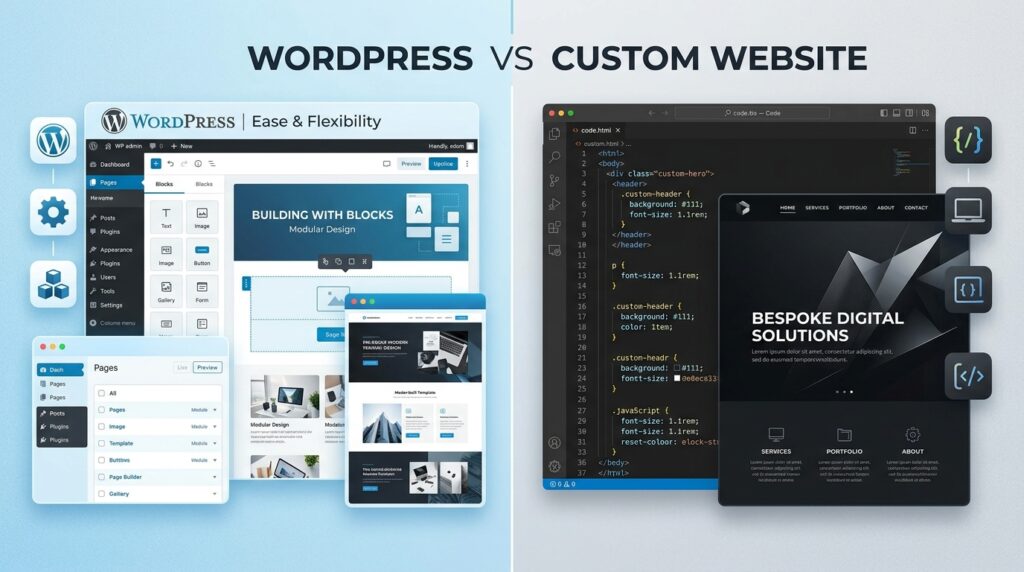
WordPress is a website building system called a CMS, short for content management system. You install it, pick a theme, add plugins for things like contact forms or online stores, and then write your pages using a simple editor. You do not need to know code to use it. According to W3Techs usage data, WordPress powers well over 40 percent of all websites on the internet, making it the most widely used CMS by a large margin. You can read more about the software itself directly on WordPress.org.
A custom website is different. A developer writes the code from scratch, using the exact features your business needs and nothing it does not. There is no theme and no page builder underneath it. Everything on the page exists because you asked for it.
Neither one is better in every case. They are built for different jobs.
Custom Website vs WordPress for Business in 2026
Here is the short version, if you only have a minute.
Choose WordPress if you publish new content often, need several people to edit the site without a developer, run a big product catalogue, or want to launch fast on a smaller budget.
Choose a custom website if speed and Google ranking are critical to your sales, your site rarely changes once it is live, you need features no plugin offers, or you want a site that looks nothing like a template.
Most small businesses can succeed with either choice if it is built properly. The mistake is not in picking WordPress or custom. The mistake is picking one without checking if it matches how your business actually works.
Cost Comparison: What You Pay Now and What You Pay Later
Cost is where most business owners get surprised. The sticker price is not the real price.
A basic WordPress website usually costs less to launch. You might pay anywhere from a few hundred dollars for a simple template site to a few thousand for a custom designed WordPress build. A custom coded website almost always costs more upfront, since a developer is writing every line by hand.
But the story changes after launch. A typical WordPress business site needs:
- A premium theme, often 50 to 200 dollars a year
- Plugins for SEO, forms, security, and backups, often 100 to 500 dollars a year combined
- Hosting built for WordPress, usually 20 to 100 dollars a month
- Someone to keep the core software, theme, and plugins updated
Add it up over three years and many WordPress owners end up paying more than they expected, especially if they hire someone to manage it properly. A custom website, once built well, needs far less ongoing work. There are no plugin subscriptions to renew and no weekly update cycle. Your main ongoing cost is developer time when you want a new feature.
If you are working with a tight budget and need to launch this month, WordPress usually wins on day one. If you are thinking three to five years ahead and your site will not change much, custom development often works out cheaper over its full life. If you want to see how the numbers move for different project types and page counts, our team breaks down real pricing on our affordable web design services guide.
Speed and Performance
Website speed is not just a nice to have anymore. Google uses page speed as a ranking factor, and slow sites lose customers before the page even finishes loading.
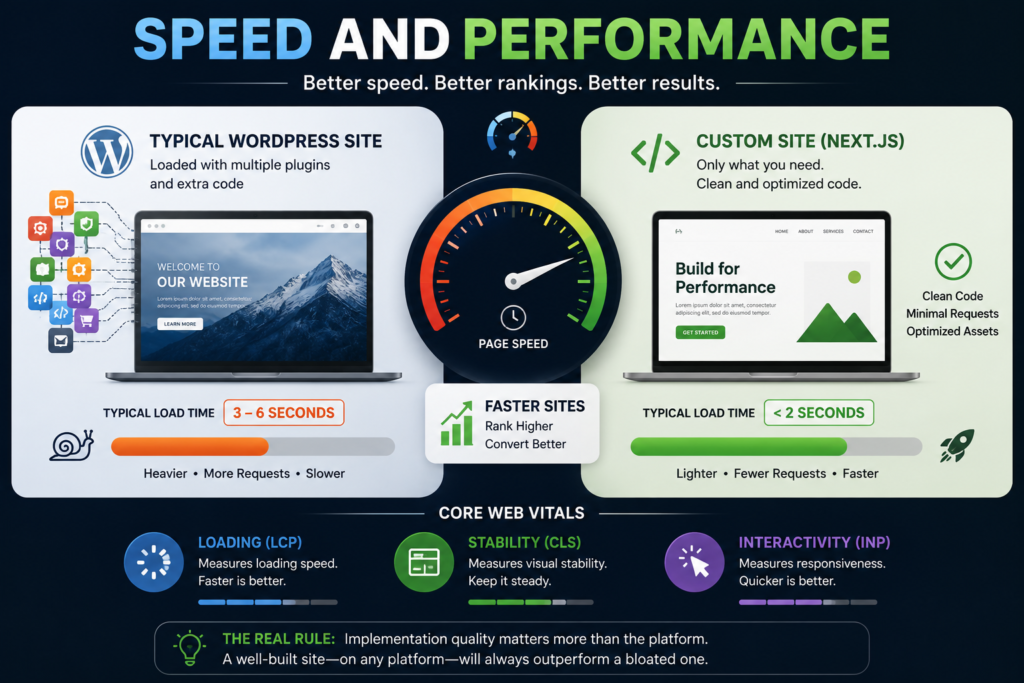
A typical WordPress site loads in three to six seconds because it usually carries fifteen to thirty plugins, each one adding its own code. A well built custom site, using something modern like Next.js, often loads in under two seconds because it only includes what it truly needs.
This does not mean WordPress has to be slow. A lean WordPress build with a fast theme, good hosting, and only a handful of plugins can perform very well. The real rule is this. Implementation quality matters more than the platform you pick. Google measures this directly through a set of metrics called Core Web Vitals, which track loading speed, visual stability, and how quickly a page responds to clicks. A poorly built custom site can be slower than a well optimized WordPress site, and a bloated custom site is just as possible as a bloated WordPress one.
If your business depends on fast pages, such as an online store or a local service business competing for search traffic, speed should weigh heavily in your decision.
SEO and Getting Found on Google
Both platforms can rank well on Google. The difference is in how much work it takes to get there.
WordPress, paired with a plugin like Yoast or RankMath, handles the basics of SEO well. Meta titles, sitemaps, schema markup, and readable URLs are all easy to set up. For most small businesses, this is more than enough.
Custom websites give you more control over technical SEO from the ground up, including page speed, clean code, and structured data built exactly the way you want it. This matters most for larger sites, sites with thousands of pages, or businesses competing in a tough niche where every technical detail counts.
Whatever platform you pick, Google’s own guidance on helpful, people first content matters more than the platform underneath it. Clear writing that actually answers the reader’s question will outperform thin content on either system.
There is a newer piece of the puzzle too. Search behaviour is shifting toward AI tools like ChatGPT, Perplexity, and Google AI Overview. This is sometimes called Generative Engine Optimization, or GEO. Sites with clean, fast, well structured code tend to get read and quoted by these AI tools more easily, because crawlers can understand the content without fighting through extra layers of plugin code. Whichever platform you choose, structuring your content clearly with direct answers near the top of each section gives you a real shot at appearing in AI generated answers. We cover this shift in more depth in our guide to GEO and how it changes search in 2026.
Security
WordPress powers a huge share of the internet, and that popularity is exactly why it gets targeted by hackers more often than smaller platforms. Almost all WordPress hacks come from outdated plugins, weak passwords, or cheap hosting rather than flaws in WordPress itself. Keep the core software, theme, and plugins updated, use strong passwords, and choose solid hosting, and a WordPress site can be very safe.
Custom websites are less visible to automated attacks simply because there is no common blueprint hackers already know how to exploit. That does not mean they are automatically safer. Custom code still needs proper security practices, and if the developer misses something, that gap can sit there for years unnoticed. Custom sites need fewer routine patches, but the patches they do need require more specialized help.
Neither platform gives you a free pass on security. Both need someone paying attention.
Design and Branding
A WordPress theme, even a premium one, is still built to work for thousands of different businesses. Someone who looks closely can usually tell a site is running on a common theme. If your brand depends on standing out or you are selling a premium service, this can quietly work against you.
A custom website gives you a design that matches your brand exactly, down to the smallest animation or layout choice. This matters most for businesses where first impressions carry a lot of weight, like law firms, high end product brands, agencies, or startups trying to look established.
If your business is more about function than image, a well designed WordPress theme, properly customized, can look just as professional to the average visitor.
Maintenance: Who Keeps the Site Running
This is the part business owners underestimate the most.
WordPress is what people call a living system. Every month brings updates to the core software, the theme, and every plugin installed. When updates apply cleanly, you never notice. When they clash with each other, which happens more often than you would think, the site can break or misbehave until someone fixes it. Many WordPress sites end up carrying twenty to forty plugins after a few years, and each one is one more thing that can go wrong.
A custom website has a much smaller update surface. No plugin conflicts, no mandatory weekly patches. Most business owners update their site content two or three times a year at most, so the constant editing WordPress offers often goes unused anyway.
Ask yourself honestly how often your team will actually log in and make changes. If the answer is often, WordPress earns its keep. If the answer is rarely, a custom site with a simple content dashboard may serve you just as well with far less upkeep.
Scalability and Special Features
If your business needs something specific, like a client dashboard, a custom quote calculator, a deep integration with your CRM, or even an AI chatbot for customer support, this is where WordPress plugins start to show their limits. A plugin is built to solve a general problem for thousands of different sites. The moment your needs step outside that general use case, you either pay a developer to build a custom plugin on top of WordPress, which can be fragile, or you move into custom development territory anyway.
WordPress does scale well for content heavy growth, such as adding hundreds of blog posts, building out a large WooCommerce store, or running a membership site. Custom development scales better for complex workflows, automation, high traffic loads, and features that do not follow a standard pattern. If ecommerce is part of your plan either way, it helps to know which tools actually support growth instead of slowing you down. Our roundup of ecommerce tools that help online stores scale is a useful next read.
The Third Option: AI Website Builders in 2026
Most articles comparing custom website vs WordPress for business in 2026 leave out a option that has grown fast this year. AI powered website builders now let you describe your business in a few sentences and get a working site back in minutes, with copy, images, and layout already filled in.
These tools are genuinely useful for a very early stage business, a personal brand, or a quick landing page to test an idea before investing more. They are fast and cheap. But they come with real limits. You have little control over the underlying code, SEO customization is often shallow, and once your business grows past the basics, you usually end up migrating to WordPress or custom development anyway.
Think of AI builders as a starting point, not a long term home for a serious business. If your business plans to grow past a single landing page, treat this as a temporary step rather than your final answer.
Headless WordPress: The Hybrid Option
Here is a gap most comparisons skip completely. You do not have to choose purely between classic WordPress and a fully custom build. Headless WordPress uses WordPress as the content backend, where your team writes and publishes normally, while a modern framework like Next.js handles what visitors actually see.
This setup gives your marketing team the familiar WordPress editing experience they already know, combined with the speed and design freedom of custom code on the front end. It costs more to set up than a standard WordPress site, and it needs a developer who understands both systems, but it often lands as the best middle ground for content heavy businesses that also care deeply about site speed. If your team enjoys writing content but you are also curious about modern frameworks, our breakdown of whether Angular is still relevant for web apps in 2026 is a helpful companion read on where custom frameworks stand today.
Common Myths About Custom Website vs WordPress for Business in 2026
A lot of bad decisions come from myths that keep getting repeated online. Let us clear a few up.
Myth: WordPress is only good for blogs. Not true. Modern WordPress runs full online stores, booking systems, membership platforms, and corporate sites for large companies.
Myth: Custom websites are only for big enterprises. Not true either. Custom development has gotten more accessible, and many small businesses with clear, specific needs choose custom from day one.
Myth: WordPress is unsafe. WordPress itself is not the weak point. Outdated plugins, weak passwords, and cheap hosting cause almost every WordPress hack.
Myth: Custom sites never need maintenance. They need far less than WordPress, but they still need updates, monitoring, and occasional developer attention.
Myth: You have to pick one platform forever. Businesses migrate between WordPress and custom all the time as their needs change. Your first choice is not a life sentence.
How to Decide: A Simple Checklist
Go through these questions honestly. Count how many favor each side.
WordPress fits you well if:
- Non technical staff need to publish content weekly or more
- You need a large product catalogue with WooCommerce
- Your budget for launch is limited
- Your site needs standard features that common plugins already cover
- You want to be live within a few weeks
Custom development fits you well if:
- Page speed and Google ranking directly affect your sales
- Your site changes rarely once it is live
- You need features no plugin handles well, like custom dashboards or unusual integrations
- Your brand depends on a design that does not look like anyone else’s
- You are planning for years of growth without a redesign
If you scored close to even on both sides, headless WordPress is worth a serious look as your middle path.
Real Examples: Which Businesses Pick Which
A local bakery that posts new specials every week and wants an online ordering form is a strong fit for WordPress. Easy updates, low cost, and WooCommerce covers the ordering.
A law firm competing for high value clients in a competitive city often chooses custom. Page speed and a design that signals trust and expertise matter more than frequent blog posts.
A SaaS startup building a product with a client dashboard, billing integration, and custom workflows almost always needs custom development, since no plugin can replicate software that specific.
A growing agency that publishes content constantly but also wants fast, polished pages for potential clients often lands on headless WordPress, getting the editing ease of WordPress with the speed of custom code.
Moving From WordPress to Custom or Back Again
Business needs change, and migrating between platforms is more common than people think. If you are moving from WordPress to custom, the biggest risk is losing your SEO rankings during the switch. Every old URL needs a proper redirect to its new page, your metadata needs to carry over exactly, and your site structure should stay familiar to both visitors and Google. Skipping this step is the single most common reason businesses lose traffic after a rebuild.
If you are moving from custom back to WordPress, usually because your team needs easier self editing, the process is similar in reverse. Content needs to be imported carefully, and your technical SEO setup needs to be rebuilt inside the new plugin ecosystem.
Either direction, plan the migration with someone who understands both platforms, and never flip the switch without a full backup and a tested redirect plan.
Actionable Tips Before You Decide
- Write down exactly how often your team will update the site, not how often you hope to
- List every specific feature you need and check if a trusted plugin already does it well
- Ask any agency for real client examples on the platform you are considering
- Get a three year cost estimate, not just the launch price
- Test page speed on a demo or an existing similar site before committing
- Keep future growth in mind, not just what you need on launch day
Conclusion
There is no single winner in the custom website vs WordPress for business in 2026 debate, and anyone who tells you otherwise is probably trying to sell you something. WordPress remains a smart, affordable choice for content driven businesses that need frequent, easy updates. Custom development earns its higher price tag when speed, unique features, and long term cost control matter more than day to day editing. Match the platform to how your business actually operates, not to what sounds impressive, and your website will serve you well for years instead of becoming another project you have to redo.
FAQs
Is WordPress still good for business websites in 2026?
Yes. WordPress remains a solid choice for most small and medium businesses, especially ones that publish content often and need non technical staff to make updates.
Is a custom website worth the extra cost?
It is worth it when your business needs speed, unique features, or a design that stands apart, and when your site will not need frequent editing. For a simple site with standard needs, the extra cost may not pay off.
Which is faster, WordPress or a custom website?
A well built custom website is usually faster because it carries less extra code. A poorly built custom site can still be slower than a well optimized WordPress site, so build quality matters more than the platform itself.
Is WordPress less secure than a custom website?
WordPress itself is not inherently less secure. Most hacks come from outdated plugins, weak passwords, or cheap hosting rather than flaws in WordPress core.
Can I switch from WordPress to a custom website later?
Yes. Many businesses start on WordPress and move to custom once their needs grow. The key is planning proper redirects and preserving your SEO during the move.
What is headless WordPress?
It is a hybrid setup where WordPress manages your content behind the scenes while a modern framework builds the actual pages visitors see. It combines easy editing with custom level speed.
Do AI website builders replace WordPress or custom development?
Not for a growing business. AI builders are useful for a quick, early stage site, but most businesses outgrow them and move to WordPress or custom development as they scale.
How much does a custom website cost compared to WordPress?
WordPress usually costs less upfront, often a few hundred to a few thousand dollars. Custom websites cost more to build, often starting higher, but tend to have lower ongoing costs over three to five years.
