



Ten Kilobytes Against a City: V2X Sabotage
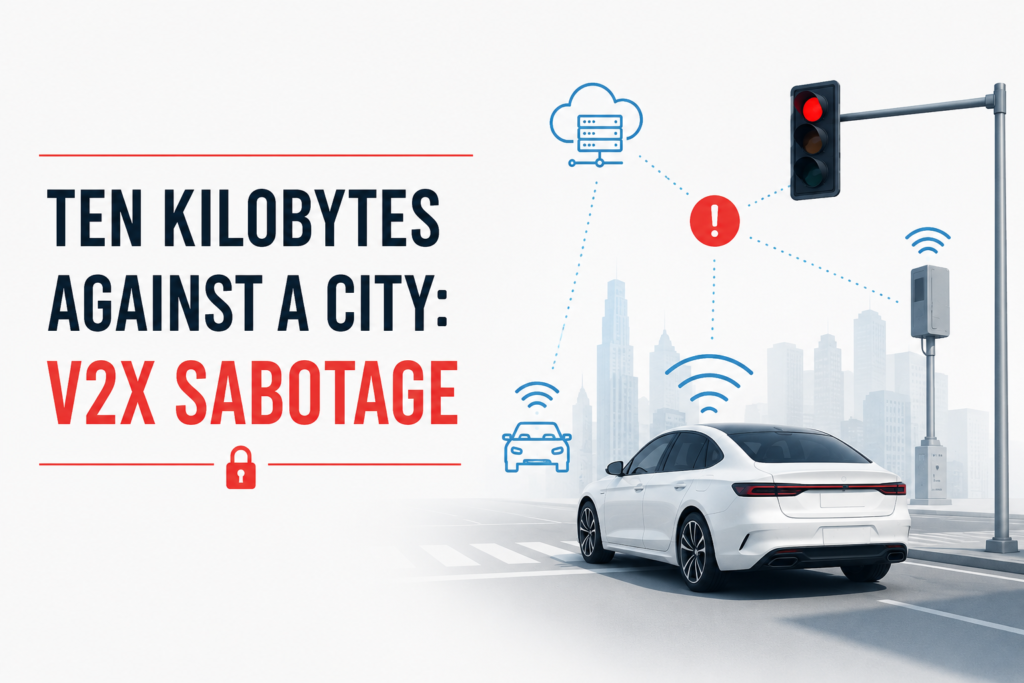
Traffic lights look harmless. They blink, they change color, they tell cars when to stop and go. But hidden inside many of these lights and roadside boxes is a tiny computer talking to every car that drives by. This computer is part of something called V2X, short for vehicle to everything.
Here is the part that should worry you. A file as small as ten kilobytes, smaller than most photos on your phone, can crash or confuse that little computer. When enough of these computers get confused at once, a whole city can grind to a stop. Security researchers now have a name for this kind of attack. Some call it a gridlock attack. Others simply call it V2X sabotage.
This article explains what V2X sabotage actually means, why it works, and what cities, engineers, and everyday drivers can do about it. We will keep the language simple, cover what other articles on this topic left out, and answer the real questions people search for.
What Is V2X and Why Cities Use It
V2X stands for vehicle to everything. It is the technology that lets a car talk to almost anything around it.
- Vehicle to Vehicle (V2V): cars warning each other about sudden braking or crashes ahead
- Vehicle to Infrastructure (V2I): cars talking to traffic lights, road signs, and toll booths
- Vehicle to Pedestrian (V2P): cars getting alerts when a person is about to cross
- Vehicle to Network (V2N): cars connecting to cloud systems and city control centers
Cities love this technology because it saves lives and time. A traffic light that knows an ambulance is coming can turn green early. A car that knows the light ahead is about to turn red can slow down smoothly instead of braking hard.
Most of these messages travel over two main systems, called DSRC and C V2X. Both rely on small roadside computers called Roadside Units, or RSUs. Each RSU usually covers around 300 meters and constantly shares signal timing, speed advice, and hazard warnings with nearby cars. According to Wikipedia’s overview of vehicle to everything technology, governments in the United States, the European Union, and South Korea are all actively pushing this system forward because of its safety benefits.
That is the upside. Now let us look at the part competitors barely touch.
How Ten Kilobytes Can Cause a Gridlock
Picture the city’s V2X network as a nervous system. Every RSU is a nerve ending. It sends and receives small packets of data all day long.
Now picture one flaw. Not a rare, expensive exploit. Just a simple, well known type of bug called a memory allocation error. This kind of bug happens when a device is not given enough room to safely handle unexpected data. It is common in embedded devices where engineers are racing tight deadlines and full safety testing sometimes gets skipped.
An attacker who finds this flaw does not need special equipment. They just need to send a small, malformed packet, often under ten kilobytes, to the RSU. Two things usually happen next.
- The RSU crashes and stops working
- Or worse, it keeps running but starts sending false signal data
The second outcome is more dangerous. A crashed light is obvious. A light quietly sending wrong information looks completely normal from the outside.
Here is the part most articles skip. One broken RSU is a minor headache. But modern traffic systems are connected. They share status updates and adjust to each other automatically. If an attacker triggers failures across a cluster of RSUs, nearby intersections start reacting to bad data at the same time. Traffic backs up, emergency routes get blocked, and there is no obvious cause because every light still looks fine from a driver’s seat.
Academic researchers have studied similar failure patterns directly. A team from RIT built a real testbed using LTE and 5G V2X hardware and showed that a well designed denial of service attack could cut message delivery by 90 percent within seconds, according to their published study on C V2X protocol attacks. That is not theory. That is a measured result on real equipment.
The Weak Points Hiding Inside Smart Traffic Systems
Engineers who build these systems are not careless. Most follow serious standards like ISO 21434, which covers road vehicle cybersecurity, and UNECE WP.29, which sets international vehicle safety rules. But standards describe what should happen. They do not write the actual code.
Here are the pressure points that show up again and again in real deployments.
- Slow certificate revocation. V2X uses a system of digital certificates to prove a message is trustworthy. Canceling a stolen or fake certificate across an entire city network can take hours, leaving a window for replay attacks.
- Weak secure boot support. Some roadside hardware cannot fully verify that a firmware update is genuine, which means a fake update could be pushed if signing checks are incomplete.
- Inconsistent message checking. The C V2X standard requires message authentication, but it does not force every device to check every message at the same strict frequency. That gap gets filled differently by every manufacturer.
- Jamming and spoofing. Since V2X runs on radio frequencies, a strong enough signal nearby can drown out real messages or fake new ones.
- Sybil style attacks. A single attacker can pretend to be many vehicles at once, confusing traffic algorithms that expect normal, honest reporting.
A broader academic survey on V2X security backs this up, noting that the highly dynamic, mobile nature of vehicular networks makes these systems especially hard to lock down compared to fixed computer networks, as described in this review on security challenges in V2X communications.
Real World Evidence This Risk Is Not Theoretical
It is easy to treat this like science fiction. It is not.
Northeastern University researchers found real vulnerabilities in the wireless connectivity stacks of Tesla’s Model 3 and Cybertruck, showing that hackers could intercept communications, disrupt network performance, and even abuse emergency alert systems. The researchers were clear that this risk is not unique to one brand. Any connected car relying on similar cellular hardware faces the same exposure.
At the policy level, ENISA’s 2025 Threat Landscape report found a sharp rise in attacks on transportation infrastructure across the European Union, with smart mobility systems flagged as a growing target for both criminal groups and state linked actors.
In the United States, NHTSA’s safety assessments of automated and connected vehicles have repeatedly pointed to implementation mistakes, not gaps in the written standards, as the real source of most security failures. In plain terms, how the code is actually built matters more than what the rulebook says it should do.
What Competitors Miss: The Human Side of V2X Sabotage
Most articles on this topic talk only to engineers. They skip what actually matters to regular people. Here is what a V2X sabotage event really looks like from the ground.
- An ambulance that normally reaches a hospital in three minutes takes nine, because every light on its usual route is stuck or lying about its status.
- During an evacuation, a jammed on ramp does not just cause delay. It can trap thousands of people who have nowhere else to go.
- A delivery driver, a school bus, and a parent picking up a kid all hit the same silent failure at the same time, with no warning and no visible cause.
- City staff spend hours trying to find a hardware fault, when the real problem is a hostile signal sent from a laptop miles away.
This is why the attack has such a strange kind of power. It costs almost nothing to attempt, it can be launched from a distance, and it is genuinely hard to trace back to a person. Security researchers sometimes call the protective boundary a city builds around its own movement its digital border. When that border is thin, the effects are not abstract. They show up as real delays, real risk, and real cost.
Building a strong digital border takes more than good code. Cities also need trained people watching for unusual patterns, responding fast, and coordinating with vendors. Growing that kind of team touches the same basics covered in this guide on skills every new professional needs to build early in their career, since hiring and training the right security and operations staff is just as important as the technology itself.
How Cities and Engineers Can Defend Against V2X Sabotage
There is no single fix, but there are clear, practical steps that reduce the risk significantly.
- Shrink the certificate revocation window. Faster, automated revocation systems close the replay attack gap that slow PKI processes leave open.
- Require full secure boot on every RSU. No firmware should run unless it is properly signed and verified, every single time.
- Standardize message checking frequency. Do not leave this detail up to each vendor. Set a strict, shared baseline across the whole city network.
- Add anomaly detection. Systems that watch for strange traffic patterns can catch a gridlock attack early, sometimes before drivers even notice a problem. Many cities are already testing AI based monitoring tools similar in concept to the support systems covered in this breakdown of AI chatbots built for fast, automated response, applied instead to traffic anomaly alerts.
- Build in manual overrides. Traffic engineers should always be able to switch a compromised intersection to a safe default state by hand.
- Follow ISO 21434 and WP.29 rigorously, not just on paper. Compliance checklists mean nothing if the actual firmware review process is rushed.
- Test like an attacker would. Regular penetration testing on RSUs and V2X gateways catches the same simple bugs before someone else finds them first.
- Treat infrastructure risk like any other safety inspection. The same logic that applies to physical safety checks, similar to how property safety and compliance certificates protect buildings, should apply to digital infrastructure audits for smart city hardware.
Simple Steps Everyday Drivers Can Take
You do not need to be an engineer to protect yourself. A few simple habits help.
- Keep your car’s software and infotainment system updated, since manufacturers regularly patch known V2X and connectivity flaws.
- If a traffic light or smart sign behaves strangely for no reason, report it to your city’s transportation department instead of assuming it is a random glitch.
- Do not fully rely on automated driving alerts near intersections. Treat V2X warnings as a helpful extra layer, not a replacement for looking both ways.
- If you drive for a living or manage a fleet, ask your provider what security standards their connected systems follow. Ride hailing and delivery platforms depend on the same city networks, similar to how the companies compared in this list of ride hailing app development providers build directly on top of this same connected infrastructure.
Content Gaps Competitors Left Out
Most existing articles on V2X sabotage, including the one currently ranking for this exact title, stop at describing the attack. They rarely explain the following, which we cover in full above.
- A plain language definition of V2X for readers who are not engineers
- A clear, numbered list of defense steps cities can actually apply
- Practical advice for regular drivers, not just city planners
- Direct citations to real, dated research and government sources instead of general claims
- An honest look at the human cost of a gridlock attack, not just the technical mechanism
If you are researching this topic for city planning or engineering decisions, treating digital infrastructure risk with the same seriousness as any other critical system failure, the same way businesses treat operational risks like the ones explained in this guide on cooling tower problems and how they are fixed, is a useful way to frame the conversation for non technical stakeholders.
Frequently Asked Questions
What does V2X sabotage actually mean?
V2X sabotage means deliberately attacking the wireless communication between vehicles and roadside infrastructure, usually to crash devices, spread false traffic data, or trigger citywide congestion.
Can a small file really cause a gridlock attack?
Yes. Some real world vulnerabilities involve packets smaller than ten kilobytes exploiting simple memory handling bugs in roadside unit firmware, not complex zero day exploits.
Is this only a risk for self driving cars?
No. V2X exists in many regular connected cars too, and roadside infrastructure itself is often the weaker link, not the vehicles.
What is the difference between DSRC and C V2X?
DSRC is an older Wi Fi based standard for direct vehicle communication. C V2X uses cellular network technology and is now the more common choice in new deployments.
Who is responsible for fixing these vulnerabilities?
Responsibility is shared between hardware manufacturers, embedded software developers, city transportation departments, and the standards bodies behind ISO 21434 and UNECE WP.29.
Are there any confirmed real world V2X sabotage incidents?
Public reporting so far focuses mostly on research demonstrations and rising attack attempts, such as those tracked by ENISA, rather than confirmed large scale city outages. However, researchers agree the risk is architectural, not hypothetical.
Final Thoughts
A traffic light is a small thing. A city depending on thousands of them talking to each other is not. V2X sabotage is not about one broken device. It is about what happens when small, quiet failures line up across a whole network at once.
The good news is that this risk is manageable. Faster certificate systems, strict firmware checks, honest testing, and simple public awareness all reduce the danger significantly. Cities that treat this as seriously as any other safety system will be the ones ready when someone actually tries it.
