



Cooling Tower Problems: 4 Risks & How to Fix Them
Think of a cooling tower like a giant version of your body sweating on a hot day. When you sweat, water evaporates off your skin and cools you down. A cooling tower does the same thing, but for huge machines instead of people.
It takes hot water from a factory, hospital, mall, or office building. It sprays that water through the air and lets some of it evaporate. That evaporation pulls the heat away, and cooler water goes back to do its job again.
It is a simple idea. But cooling towers run for years, sitting outside in sun, rain, and dust, holding thousands of gallons of warm water. That is exactly the kind of environment where things go wrong. Minerals build up. Metal rusts. Germs grow. Fans and motors wear out.
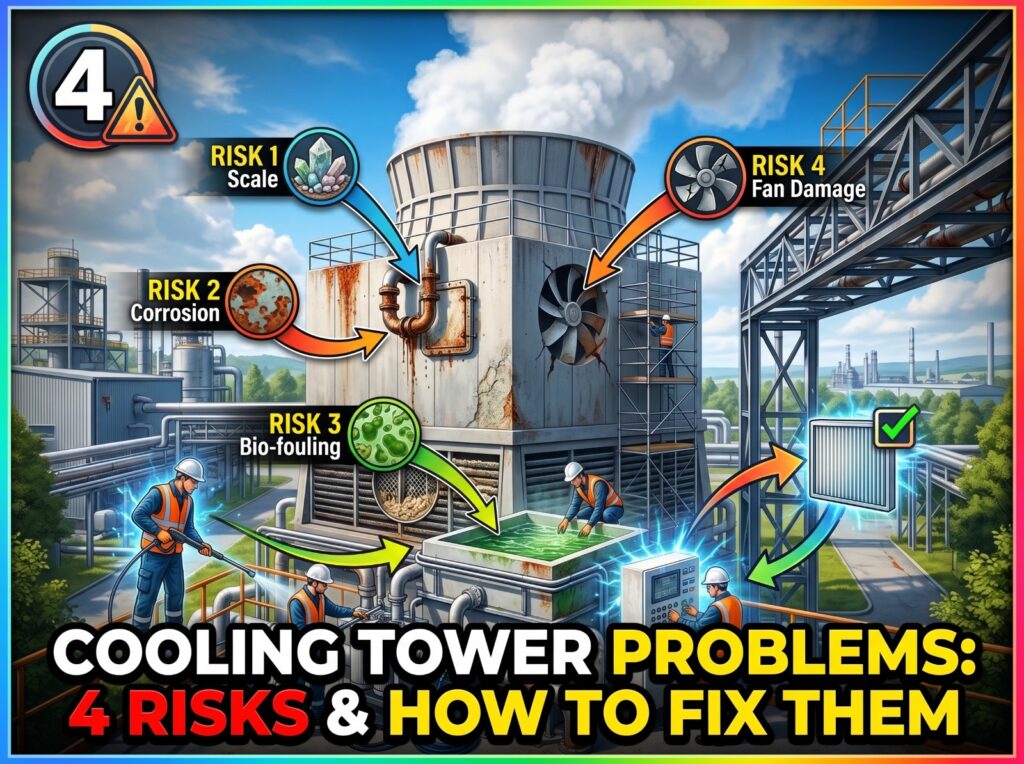
When Cooling Tower Problems: 4 Risks & How to Fix Them show up and nobody catches them early, the bills go up, the equipment breaks down, and in the worst cases, people get sick. This guide walks through the four biggest cooling tower problems, how to spot them early, and exactly what to do to fix them, written in plain language with real numbers, not just theory.
What Is a Cooling Tower and Why Do Problems Happen?
A cooling tower has a few main parts:
- A basin at the bottom that holds water
- Fill material inside the tower that breaks water into thin sheets so it cools faster
- Nozzles that spray water over the fill
- A fan on top that pulls air through the tower
- Pumps and pipes that move water to and from the building
Water is always evaporating a little bit, which means fresh water keeps getting added. Every time fresh water comes in, it brings minerals, dirt, and tiny organisms with it. Over time, those things build up inside the tower. That is the root cause behind almost every problem you will run into.
The good news is that nearly every one of these problems gives off warning signs weeks or months before it becomes serious. You just need to know what to look for.
The 4 Biggest Cooling Tower Problems and How to Fix Them
1. Scale and Mineral Buildup
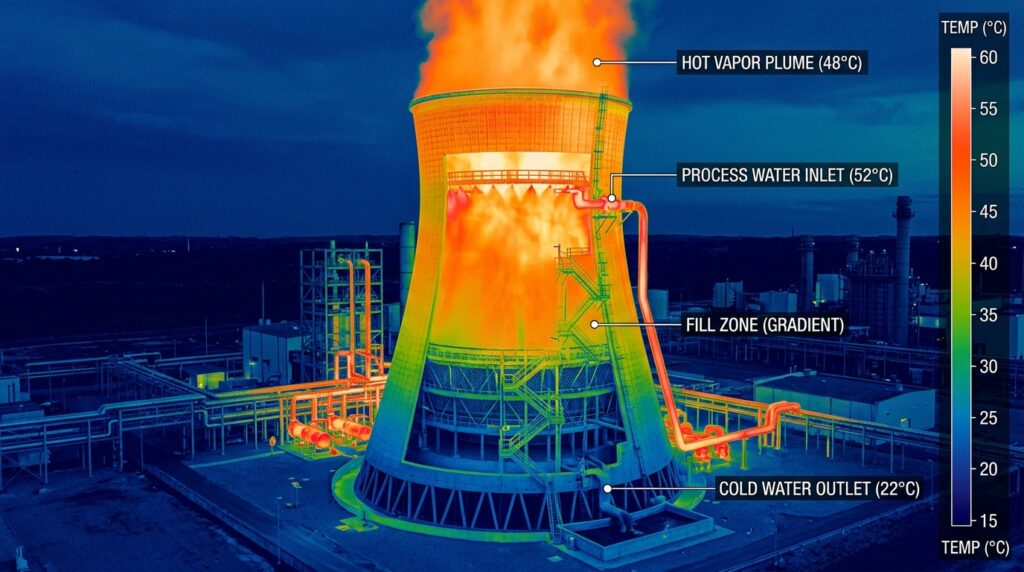
What it is: Water carries dissolved minerals like calcium and magnesium. As water evaporates inside the tower, those minerals get left behind and stick to surfaces, kind of like the white crust you see around a kettle after boiling water in it for months. That crust is called scale.
Why it is a problem: Scale acts like a blanket over the parts of the tower that are supposed to transfer heat. A layer of scale as thin as a coin can cut heat transfer efficiency by 15 to 30 percent. That means the system has to work harder and use more electricity just to reach the same cooling result. The Department of Energy’s guidance on cooling tower management best practices</a> covers exactly why controlling mineral concentration matters so much for efficiency.
Warning signs:
- Chalky, white deposits on pipes, nozzles, or the fill
- Water flow slowing down through spray heads
- Energy bills climbing even though nothing else changed
- The building feels warmer even with the cooling system running normally
How to fix it:
- Test the water hardness and pH. Most water treatment companies can do this in minutes.
- Increase blowdown, which means draining off some concentrated water on purpose so fresh water dilutes the minerals. Think of it like changing bathwater instead of letting it get dirtier and dirtier.
- Add a scale inhibitor chemical, dosed automatically through a feed pump.
- For existing scale, use a descaling acid wash on badly affected parts, or replace the fill if it is too far gone.
- Set up a water meter or conductivity controller so blowdown happens automatically instead of by guesswork.
A quick way to remember it: scale is a water chemistry problem first, and a cleaning problem second. Cleaning it off without fixing the water chemistry means it just comes back.
2. Corrosion and Structural Decay
What it is: Corrosion is what happens when metal parts of the tower, steel frames, basins, and pipework, slowly get eaten away by water that is too acidic, too oxygen rich, or just poorly balanced.
Why it is a problem: Corrosion does not stay small. It starts at welds and joints, becomes small pits, and eventually weakens the metal enough that basins leak or structural supports fail. A tower that looked fine last year can develop a serious leak or even a safety hazard if corrosion has been quietly working underneath the surface.
Warning signs:
- Rust stains on the basin, frame, or nearby concrete
- Reddish or brown tint in the circulating water
- Pinhole leaks that keep reappearing in the same general area
- Flaking paint or coating on steel components
How to fix it:
- Check pH regularly. Most systems should stay between 7.0 and 8.5. Low pH is the biggest driver of corrosion.
- Add a corrosion inhibitor chemical to the water treatment program.
- Use corrosion coupons, small metal test strips that measure how fast metal is wearing away, so you get an actual number instead of a guess.
- Sandblast and recoat areas with surface rust before it becomes structural.
- For basins with heavy corrosion, a fiberglass liner can often extend the tower’s life instead of a full basin replacement.
If corrosion has already eaten more than half the thickness of a basin wall, that is usually the point where repair stops making financial sense and replacement becomes the smarter call.
3. Biological Growth (Algae, Bacteria, and Legionella)
What it is: Warm water, sunlight, and nutrients from dust and debris create the perfect home for algae, bacteria, and fungi. These organisms form a slippery layer called biofilm on surfaces inside the tower.
Why it is a problem: This is the risk with the biggest human cost. Biofilm shelters bacteria, including Legionella, the bacteria behind Legionnaires’ disease, a serious type of pneumonia that spreads through fine water mist. According to the CDC’s Legionella control toolkit for cooling towers</a>, sediment and biofilm, water temperature, water age, and disinfectant residual are the key factors that let Legionella take hold. Cooling towers are one of the most common sources of Legionella outbreaks because the tower’s fan blows mist straight into the outdoor air.
Warning signs:
- Slimy or slippery surfaces inside the tower
- Green, brown, or black patches of growth
- A musty or swampy smell near the tower
- Cloudy water
- Rising bacteria counts in routine water tests
How to fix it:
- Keep a biocide treatment program running consistently. Do not skip doses even when the tower looks fine, since biofilm hides bacteria from treatment chemicals and consistency matters more than one strong dose.
- Alternate between two different types of biocide so bacteria do not build resistance to just one.
- Test water for Legionella and general bacteria counts on a regular schedule, at least quarterly.
- Physically clean the basin and fill during shutdowns, since chemicals alone cannot remove built up sludge and debris.
- Keep drift eliminators, the panels that catch water droplets before they escape the tower, in good condition. Damaged eliminators let contaminated mist escape into the air, which is exactly what causes exposure.
- Follow a written Water Management Plan built around industry guidelines for controlling Legionella risk. The OSHA Legionnaires’ Disease Control and Prevention Guide provides clear recommendations for inspection, operation, maintenance, and monitoring schedules to help reduce the risk of Legionella growth.
This is one area where cutting corners is not worth it. A Legionella outbreak linked to a poorly maintained tower can shut a facility down, trigger lawsuits, and in the worst cases, cost lives.
4. Mechanical Breakdowns
What it is: Fans, motors, gearboxes, and belts keep the tower’s air moving. These parts run almost constantly, often in wet, humid, and sometimes freezing conditions, so they wear out faster than equipment kept indoors.
Why it is a problem: Unlike scale or corrosion, which build up slowly, mechanical failures can happen suddenly. A seized bearing or a snapped belt can shut down cooling completely, sometimes in minutes, right when the building needs it most.
Warning signs:
- Grinding, squealing, or rattling sounds from the fan or motor
- Vibration that was not there before
- Motor running hotter than usual
- Belts that look cracked, glazed, or loose
- Oil that looks milky or has metal flecks in it, a sign the gearbox is failing
How to fix it:
- Check motor amperage against the nameplate rating regularly. A big gap between the two numbers usually points to a developing fault.
- Grease bearings on the schedule the manufacturer recommends. Skipping this is one of the most common causes of early failure.
- Inspect belts for cracking or looseness monthly, and replace them in pairs, not one at a time.
- Run a simple vibration check by hand or with a basic vibration meter. Unusual shaking almost always means misalignment or an imbalance developing somewhere.
- Keep spare parts like belts, bearings, and fuses on hand so a failure does not turn into days of downtime waiting for parts to arrive.
Cooling Tower Problems at a Glance
| Problem | Main Cause | Early Warning Sign | Quick Fix |
|---|---|---|---|
| Scale buildup | Minerals in water concentrating over time | White, chalky deposits | Adjust water chemistry, increase blowdown |
| Corrosion | Low pH, oxygen exposure | Rust stains, reddish water | Corrosion inhibitor, coating repair |
| Biological growth | Warm water, sunlight, and nutrients | Slime, odor, cloudy water | Biocide dosing, regular cleaning |
| Mechanical failure | Wear, poor lubrication, misalignment | Noise, vibration, overheating | Scheduled lubrication, belt and bearing checks |
How Much Do Cooling Tower Problems Really Cost?
Ignoring cooling tower problems does not just risk a breakdown. It quietly drains money every single day the tower runs inefficiently.
- Energy waste: A tower running at 20 percent lower efficiency uses roughly 20 percent more energy for the same cooling output. For a mid size industrial site, that can add tens of thousands of dollars to yearly utility bills.
- Emergency repairs: Fixing a problem after it causes a breakdown typically costs 2 to 4 times more than fixing the same issue during scheduled maintenance, because parts and labor both carry rush pricing.
- Downtime: For a manufacturing plant, a few hours without cooling can mean a stalled production line. For a data center, the cost of downtime can run into the thousands of dollars per hour.
- Legal and health costs: A confirmed Legionella case tied to a facility’s cooling tower can lead to regulatory fines, lawsuits, and reputational damage that outlasts the actual repair by years.
The pattern is always the same: small cooling tower problems that go unchecked turn into costly repairs. Cooling towers are often the largest source of water use in commercial buildings, so inefficiencies can quickly increase both water and energy costs. The U.S. Environmental Protection Agency (EPA) also highlights the importance of improving cooling tower water efficiency to reduce waste and operating expenses.
DIY Checks vs When to Call a Professional
Not every task needs a specialist. Here is a simple way to split the work.
You, or in house maintenance staff, can usually handle:
- Weekly visual inspections for scale, algae, rust, or debris
- Checking water clarity and smell
- Listening for unusual fan or motor noise
- Basic belt tension and visual wear checks
- Recording basin water level and makeup water use
Call a water treatment specialist or HVAC technician for:
- Water chemistry testing and chemical dosing setup
- Legionella and bacteria lab testing
- Gearbox oil analysis
- Vibration analysis on fans and motors
- Structural inspections and coating repairs
- Any repair involving electrical components or working at height
A good rule of thumb: if a task involves lab equipment, chemicals beyond basic dosing, or safety risk, bring in a professional. If it is something you can see or hear from ground level, your own team can usually catch it early.
Simple Cooling Tower Maintenance Checklist
| Frequency | Task |
|---|---|
| Weekly | Visual inspection for scale, algae, corrosion, debris; check water clarity |
| Monthly | Test water chemistry (pH, hardness, conductivity); inspect belts and nozzles |
| Quarterly | Legionella and bacteria testing; vibration check on fan and motor |
| Annually | Full structural inspection; gearbox oil analysis; drift eliminator check; basin heater test before winter |
Sticking to a schedule like this catches most Cooling Tower Problems: 4 Risks & How to Fix Them while they are still cheap and easy to handle.
Repair or Replace? How to Decide
At some point, every facility manager has to decide whether a specific part, or the whole tower, is worth fixing again.
A simple guideline used across the industry: if a single repair costs more than half the price of replacing that component, replacement usually makes better financial sense. Combine that with the tower’s age. A gearbox rebuild on a 5 year old tower is usually worth it. The same repair on a 20 year old tower with a corroded basin often is not.
Other signs it is time to replace rather than repair:
- The tower cannot hit its target cooling temperature even after fill replacement and cleaning
- Repairs are happening more than twice a year on the same component
- Structural corrosion affects the basin or main support columns
- The tower is over 20 years old and repair costs keep climbing
How to Prevent Cooling Tower Problems Before They Start
Prevention is cheaper than every fix listed above, combined. A few habits make the biggest difference:
- Keep a written maintenance log, even a simple spreadsheet, so patterns show up over time instead of surprising you.
- Never skip water treatment dosing, even during slow seasons or shutdown periods.
- Train whoever walks past the tower daily to recognize the basic warning signs of smell, sound, and appearance.
- Budget for fill and drift eliminator replacement every 10 to 15 years as a planned expense, not a surprise one.
- Schedule major repairs or replacements for spring or fall, when contractors are less busy and pricing is lower than peak summer season.
Running the Business Side of Facility Maintenance
Catching cooling tower problems early is mostly about people and process, not just equipment. If you manage a facilities or water treatment company, a few everyday business tools make that process smoother.
Clients often call with questions about unusual odors, equipment noise, or upcoming service appointments. Using an AI chatbot can provide instant responses, log service requests automatically, and ensure no inquiry is missed during busy periods.
As your cooling tower maintenance or water treatment business grows, finding the right facility managers becomes increasingly important. Email finder tools can help you identify decision-makers and build targeted outreach lists.
If you’re planning to build an internal dashboard for managing inspections, water quality tests, maintenance records, and work orders across multiple cooling towers, choosing the right technology stack matters.
Conclusion
Cooling Tower Problems: 4 Risks & How to Fix Them rarely appear out of nowhere. Scale, corrosion, biological growth, and mechanical wear all build up slowly, and they all leave warning signs long before they turn into a crisis. The facilities that avoid expensive breakdowns are not the ones with brand new towers. They are the ones with a team that checks, tests, and fixes small things on a regular schedule.
A cooling tower does not ask for much. Clean water, steady maintenance, and someone paying attention. Give it that, and it will quietly do its job for decades.
Frequently Asked Questions
What are the most common cooling tower problems?
The four most common cooling tower problems are mineral scale buildup, corrosion, biological growth including Legionella risk, and mechanical failures in fans, motors, or belts. Water chemistry issues sit behind most of these.
How often should a cooling tower be inspected?
Visual inspections should happen weekly. Water chemistry testing should happen monthly. Legionella and bacteria testing should happen at least quarterly, and a full structural inspection should happen once a year.
What causes a cooling tower to smell bad?
A musty or swampy smell almost always points to biological growth, meaning algae, bacteria, or biofilm building up inside the tower. It is a sign that biocide treatment needs attention right away.
Can Legionella really come from a cooling tower?
Yes. Cooling towers are one of the most common sources of Legionella outbreaks because their fans release fine water mist into the air. Regular testing, consistent biocide dosing, and well maintained drift eliminators lower this risk significantly.
How do I know if my cooling tower needs to be replaced instead of repaired?
If a single repair costs more than half the price of a new component, if the same part keeps failing, or if structural corrosion has spread through the basin or support frame, replacement is usually the smarter long term choice.
Is scale buildup dangerous, or just a performance issue?
Scale is not a direct safety hazard, but it is a serious performance and cost issue. It can cut heat transfer efficiency by 15 to 30 percent, forcing the system to use more energy and wear out faster.
What is the cheapest way to prevent cooling tower problems?
Consistent water treatment and a simple weekly visual inspection catch the vast majority of Cooling Tower Problems: 4 Risks & How to Fix Them while they are still inexpensive to fix. Skipping either one is the single biggest reason small issues turn into expensive breakdowns.
