



Global vs. Local Cooling Tower Manufacturers: Pros and Cons
Cooling towers keep factories, power plants, data centers, hospitals, and commercial buildings running by removing waste heat. When it’s time to buy or replace one in the US, the big choice is often global manufacturers (big international brands) versus local or domestic US makers.
Your decision affects not just the upfront price but also lead times, maintenance speed, compliance with US rules, and long-term reliability. Supply chain issues, tariffs, and a push for faster installs have made this choice even more important in recent years. Here’s a clear breakdown to help you decide which option best fits your facility.
Global Cooling Tower Manufacturers: Strengths and Weaknesses
Global players such as SPX Cooling Technologies (Marley), Baltimore Aircoil Company (BAC), EVAPCO, and others from Europe and Asia bring significant scale and resources.
Pros:
- Advanced technology and innovation: They invest heavily in R&D. Expect features like hybrid wet-dry systems, high-efficiency fill media, AI-optimized controls, and better energy performance. (Just as the 5 Best AI Chatbots for Customer Support in 2026 are streamlining client relations, smart automation is transforming industrial facility operations).” This helps meet strict efficiency standards and cut operating costs over time.
- Proven track record on big projects: Ideal for multinational companies that want the same specs across sites. They offer detailed performance data from certified labs (CTI-certified) and handle massive capacities.
- Lower initial purchase price: Mass production often means competitive sticker prices, especially for standard models.
Cons:
- Longer lead times: International shipping, port delays, and customs can mean 12-18 weeks or more. This risks project timelines in the fast-moving US market.
- Service and parts challenges: Support can feel distant. Getting technicians or proprietary parts on-site quickly is harder, leading to longer downtime.
- Tariff and supply chain risks: Trade policies can add unexpected costs (25%+ in some cases). Geopolitical issues or shipping disruptions hit harder.
- Less flexibility for local regs: They may need extra work to fully align with state-specific rules, like California’s Title 24 energy codes or seismic requirements in earthquake zones.
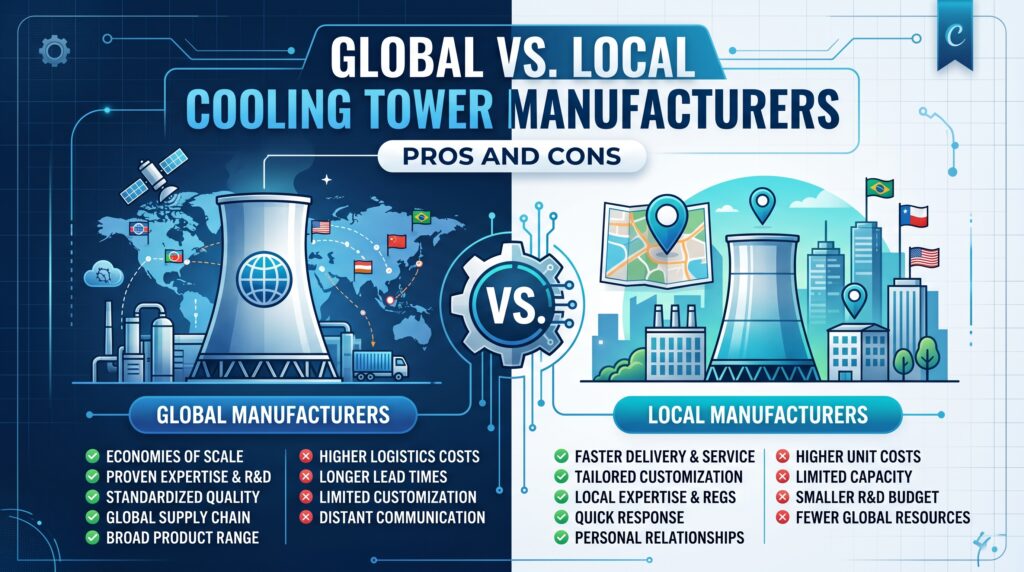
Local/US Cooling Tower Manufacturers: Strengths and Weaknesses
US-based or domestic-focused manufacturers emphasize speed, support, and American-made quality. Many use US steel, composites, or high-density polyethylene for durability.
Pros:
- Much faster delivery: Often 4-8 weeks. No ocean shipping means your project stays on schedule.
- Superior local service: Technicians can reach your site in hours, not days. They stock common parts locally and understand your exact operating conditions, climate, and water quality.
- Tariff-free and supply chain stability: No import surprises. Better alignment with “Buy American” preferences for government or funded projects.
- Strong compliance and customization: They know EPA water treatment rules, local building codes, seismic/vibration standards (ASCE 7), and incentives for energy-efficient equipment. Easier to get site-specific engineering stamps.
- High material quality and durability: Many prioritize robust US-sourced components built for tough conditions.
Cons:
- Higher upfront cost: Expect 5-15% more initially due to US labor and materials (though lower shipping often offsets this).
- Less cutting-edge R&D in some cases: They may rely more on proven designs than brand-new proprietary tech, though many partner or license innovations.
- Smaller scale: Fewer options for ultra-large or highly specialized global-standard projects.
Head-to-Head Comparison
| Aspect | Global Manufacturers | Local/US Manufacturers | Best For |
| Lead Time | 12-18+ weeks | 4-8 weeks | Local (speed) |
| Initial Price | Usually lower | Moderate to higher | Global |
| Service & Maintenance | Remote/scheduled | On-site, rapid | Local |
| Innovation & Tech | High (patented features) | Solid proven + customization | Global |
| Regulatory Compliance | Good, but needs adaptation | Excellent for US/state rules | Local |
| Tariff/Supply Risk | Higher | None | Local |
| Total Cost of Ownership | Varies (energy + downtime) | Often lower long-term | Depends on uptime needs |
| Best For | Large standardized projects | Mission-critical, fast installs | – |
Key Decision Factors for US Buyers
Uptime and Downtime Costs
If even a few days without cooling could cost thousands or millions (think data centers, pharma, or continuous manufacturing), local support wins. Fast parts and service protect your revenue.
Energy Efficiency and Sustainability
US facilities face pressure to cut water and energy use. Look for high-efficiency models (measured in GPM/HP), hybrid systems, or dry cooling options in water-scarce areas like the Southwest. Both global and local makers offer strong options, but locals often help maximize rebates and incentives.
Project Timeline and Budget
Tight deadlines or government funding? Go local. Large non-urgent capital projects with a budget focus? Global can work if you plan.
Hybrid Approach
Many US facilities buy the main unit from a global leader for advanced tech, then partner with a local service company for installation, maintenance, and ongoing support. This combines the best of both.
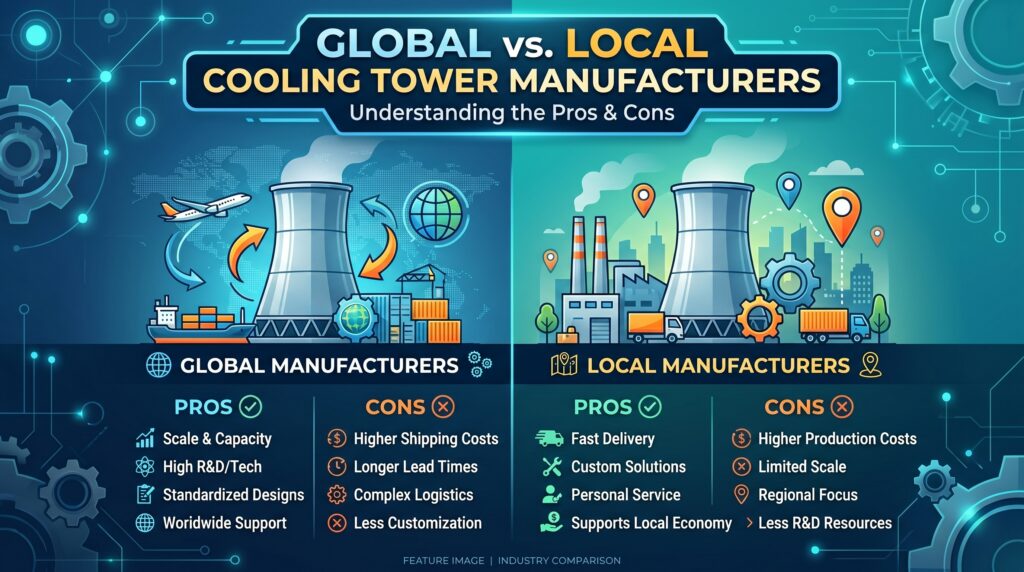
Real-World Considerations
- Water treatment and Legionella prevention: Critical everywhere, but locals understand regional water chemistry better.
- Seismic and extreme weather: Coastal or Midwest facilities need proven ratings ask for documentation.
- Total cost of ownership (TCO): Factor in shipping, installation, energy, water, maintenance, and downtime. A cheaper import can become expensive fast.
Actionable Tips for Choosing
- Define your priorities: List must-haves (speed, efficiency, budget, compliance).
- Get multiple bids: Compare apples-to-apples on performance, warranties, and TCO.
- Ask tough questions: Lead times? Parts sourcing? Local service radius? Compliance docs?
- Check certifications: CTI, ASHRAE, EPA, and local code approvals.
- Visit references or facilities: Talk to actual users in your industry and region.
- Consider future needs: Scalability, efficiency upgrades, and water conservation.
Conclusion
There’s no one-size-fits-all answer. Global manufacturers shine with innovation and scale for big, planned projects. Local US manufacturers deliver speed, support, and risk reduction that often wins for everyday operations and critical facilities.
In today’s US market, many lean local or hybrid for better resilience and lower long-term headaches. Evaluate your specific needs, timeline, and risk tolerance. Then pick the partner that protects your operations for the next 10-20 years.
alk to a few manufacturers or a neutral consultant for a site audit. The right cooling tower keeps your facility efficient, compliant, and running smoothly for years.
FAQs
What are the main differences between global and local cooling tower manufacturers?
Global ones offer advanced tech and lower initial prices but slower delivery and service. Local/US ones provide faster lead times, quick on-site support, and better regulatory fit, often with strong long-term value.
When should I choose a global manufacturer?
For large, standardized, or highly technical projects where innovation matters more than speed and you can plan months.
When is a local USA manufacturer better?
For projects needing quick installation, minimal downtime, or tight compliance with state and federal rules.
How do lead times compare?
Global/international: often 12-18 weeks. Domestic: 4-8 weeks. This gap matters for tight construction schedules.
Does choosing local help with tariffs and supply chains?
Yes— no import duties and more stable domestic sourcing reduce surprises.
What about maintenance and parts?
Local service networks make a huge difference in minimizing downtime and keeping costs predictable.
Ready to move forward? Start by listing your facility’s heat load, location challenges, and timeline—then reach out for tailored quotes. The best choice balances upfront cost with reliable, efficient performance for your unique operation.
